

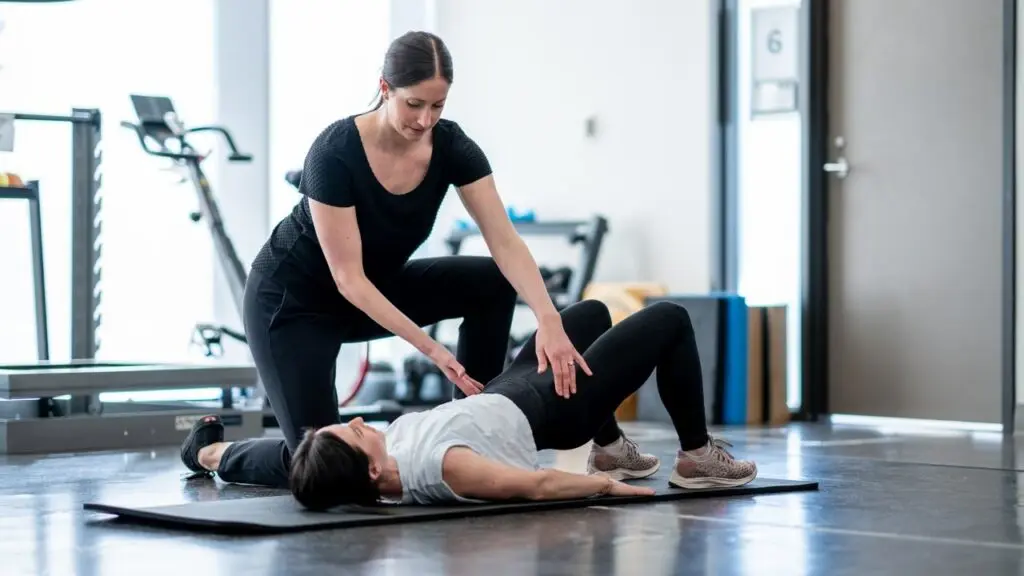
Fix Your Pelvic Tilt Without Making Back Pain Worse

One of the big problems that people make when they start trying to “fix their pelvic tilt” is that they end up doing so much posterior pelvic tilting that they make their lower back pain worse. “Fixing” something that wasn’t there in the first place. When it comes to pelvic alignment or pelvic tilt, there are many factors that create illusions that lead you to “fixing” these issues that do not exist and ultimately creating problems that weren’t there. If you can avoid this simple mistake, you’ll find you have much better success with resolving your lower back pain for good.

Is your pelvic tilt really causing your lower back pain
When it comes to looking at pelvic tilt and its effect on your lower back pain, there is one common mistake that so many make. That is assuming that the pelvis is actually tilted from a physical examination, or because when they lie down there is a gap between their lower back and the floor.
This gap is normal and what’s more it is healthy!
Your lumbar spine is supposed to be a natural backward bending curve, a strong position that allows for effective weight bearing and good mobility. Your gluteal muscles are also large muscles below your lumbar spine which often create an illusion of “too much curve” in your lower back and/or a forward tilted pelvis. On top of that, many have poor control of the lower abdominal muscles so the lower stomach “sticks out” just because it sticks out doesn’t mean that your pelvis is tilted!
Why your pelvis should have a natural tilt to it for normal anatomy.
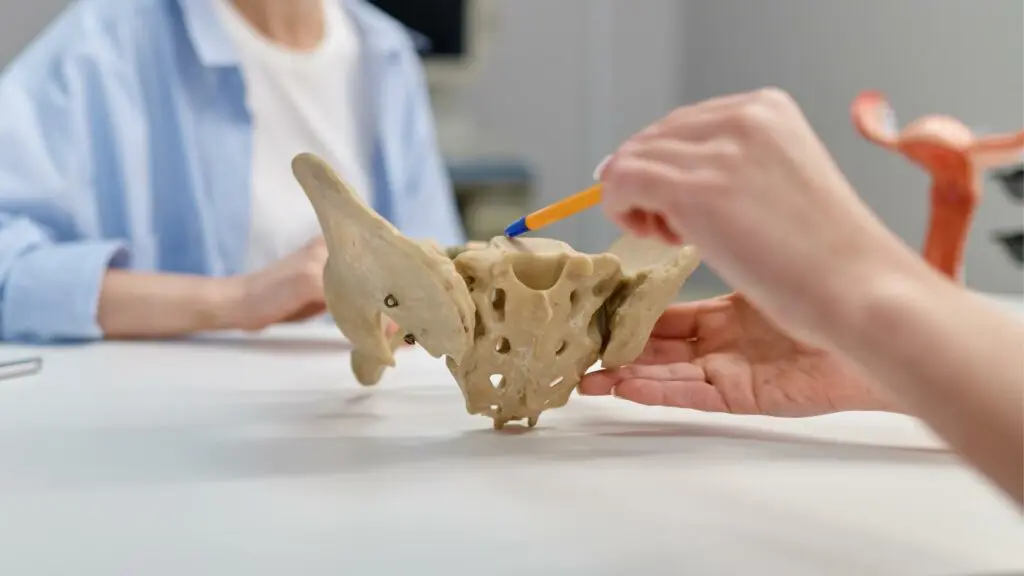
When we look at the position of the pelvis this is important for effective force transmission through the body. The “pelvic position” has a direct impact on the tailbone, your sacrum, and how it connects to your lower back. As you rock the pelvis forwards or backwards, it affects the slope that your tailbone has for the lower back to “sit on”. There should however be a “natural” slope of approximately 40 degrees compared to the horizontal, your L5/S1 disc at this important junction even has a slight wedge shape to it to accommodate this position.
On top of this anatomical concern at the level of the last joint in your lower back, we have to consider the balance between your hips and your spine. As you posteriorly pelvic tuck, as so often is the recommendation to “fix” this pelvic tilt, you actually make this balance worse! Flattening the lower back and moving the hips significantly forwards of the lower back, making for inefficient force transfer.
In simple terms this means more pressure on the spine and strain on the lower back and hip muscles!
Big Mistake: Stop “correcting” pelvic tilt with pelvic tucks
Unfortunately, too many videos online are produced by those unaware of the simple facts above, as a result pelvic tilts and “flattening the back” to the floor is the going advice, but this makes back pain worse. The simple truth is that the majority of us have “normal” human alignment, there is no need to aggressively change the direction of your pelvis in this way. Not to mention most of us spend too much time sitting every day – with a significant posterior pelvic tuck.
The only way to tell if you really have pelvic tilt or not
In all our experience working with thousands of patients over the years, there has been one significant finding, that is to say that we would measure the pelvis on spine imaging, specifically load bearing X-rays. What you find is that in most of those who have been told they have “forward pelvic tilt”, is that they in fact either have no pelvic tilt, or worse, a backward pelvic tilt!
Physical examination of pelvic tilt is practically useless and in cases as we’ve seen over the years, clinically, actually causes more harm than good.
If you think you have a pelvic tilt, or are concerned about it, measure it properly.
Fixing your pelvic tilt the right way if you have low back pain
Now that you understand that your pelvic is likely not tilted in the way so many suggest, understand that you can do work to provide stability to the lower back and improve your gross posture. To do this we have 3 short recommendations to help you make an instant improvement.
Posture fix: Realign yourself using a guide
Using a wall, with a few simple movements, none of which involve pelvic tilts, you can start to develop a better understanding of how to hold yourself. For a simple step-by-step guide on fixing your posture in under 60 seconds check out the linked resource below.
Resource: Back Pain Posture Fix In Under 60 Seconds
Hip mobility: Simple, balanced, back friendly stretching
Focusing on balanced stretching regularly to keep the muscles of the hips with a normal degree of mobility will work wonders, for more help, check out this simple routine that you can follow along with daily, to stretch out your hip muscles in a comprehensive way, it takes less than 10 minutes, but is all done in a back friendly way, again, check out the resource linked below:
Resource: 10 Minute LIVE Hip Mobility Flow For Back Pain
Building a strong posture:
Ultimately weakness in the lower back, lower core and surrounding muscles has a huge impact on the vulnerability of your lower back. Unfortunately there is a lot of confusion about how to go about strengthening to fix the lower back weakness and eliminate the pain. This is why we created a full, free 80 minute “fixing back pain” masterclass which will give you exactly the exercises to strengthen that lower back, lower core and the hips in general to help resolve your lower back pain for good. Check out the resource linked below for the full video that’s already helped thousands around the world.
Resource: Fixing Back Pain Masterclass
Final thoughts on pelvic tilt and lower back pain
Over the years we’ve seen thousands of patients with lower back pain, with spinal imaging, the simple truth is, if there is any misalignment in the lower back and pelvic area in the cases with long standing lower back pain, it is almost always a flattened lower back, and a posterior pelvic tilt. Which makes complete sense given the way we use our bodies nowadays.
The truth is that most clinicians have not worked this closely with spinal imaging, and they often do not have the skillset to evaluate it in this way even if they did. Too many are ready to “fix your alignment” without any concrete measurements let alone an awareness of what such measurements might be, or how to take them.
Focus on the 3 resources linked above if you’ve been struggling with your lower back pain, they will help you maintain a strong lower back and support good neutral alignment!


Responses