
When it comes to recovering from lower back pain or sciatica it can be tempting to look for special secret exercises and complex “special approaches” to resolve your specific back injury. But what if we’re all overcomplicating things. The more and more time goes on, it seems that there could be a much simpler approach that really works to resolve back pain by focusing not on the pain but on back health.
By having the goal of building a strong and healthy spine, with exercise selections that anyone can do, we have the ability to take anyone, no matter what their specific diagnosis, from a raging herniated disc, or pre and post back surgery, to the minor case of lower back pain. They all have one thing in common. Impaired back health.

What makes a healthy back?
The low back should have the ability to bear load, the hips should be mobile so they can work closely with the low back in everyday movements, and you should be able to control and stabilise your spine at will. The spine should also be able to move through ranges of motion in all directions freely.
How can we rebuild a healthy back?
Very simply using exercises over time we can restore all of the above parameters into the lower back, but the exercises should meet three specific criteria:
- They should be accessible to all abilities so that anyone can begin them, no matter their ability or inability.
- They should have some utility in everyday life so that improvements can be quickly utilised to lessen daily strain on the back.
- They should be easily scalable so that you can progress and build with relative ease so you’re not having to continually learn new exercises.
Aiming for back health instead of a specific pain or diagnosis
By aiming at back health we know that we are working in the right direction, while there might be unique challenges in achieving this with the given set of exercises, it is not the selection of exercises that need tailoring, but the strategies one might employ to make sure they can do the given selection of exercises without significant pain or aggravation.
Approaching exercises for your back health the right way
How we approach exercises will directly affect the success or failure of your back recovery. Too many approach the exercises in a casual manner. You should be looking to perform the given exercises for 3 sets of 10 reps, with something like 30 to 60 seconds of rest between each set.
Your first task however, is to “play around” with 10 reps of the selected exercise, Looking to see what “version” of the exercise you can do 10 reps for, as perhaps you struggle to perform even 1 rep without pain. This is ok, you need to then try an easier version of the chosen exercise. This is where you are acting like a student or practitioner, looking specifically for where things went wrong. At what precise point did pain trigger, and what if you do X,Y or Z to modify the movement, does that eliminate the aggravation, or delay it for a few more reps.
For the 5 exercises we’re covering here, you’ll find tutorials which you can use to help you in this discovery phase.
Exercises for a healthy back: The Core 5 For Spine Health
These 5 exercises adhere to the 3 criteria we mentioned earlier and they all challenge you in specific ways, there are specific “errors” that you will make that give rise to pain or aggravation as you fail specific stabilising actions. Therefore by making the exercise easier or harder you can adjust the challenge for each of the exercises. It also makes troubleshooting much easier as there are a limited number of ways things can go wrong for each!
Remember that your aim throughout these exercises is to hold the spine stable, that means it does not move, bend, twist, round or arch! To the degree you fail to do this, you “fail” the exercise, work at it, practice it, but do not be discouraged, the mistakes you will make will rear their heads again as you progress, add difficulty and challenge yourself. It is an ongoing process of building health back in.
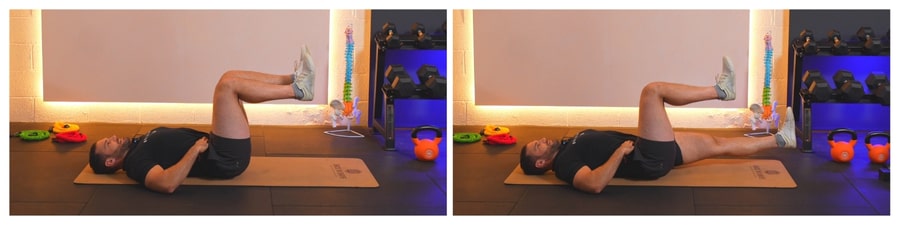
Deadbug modified: off load spine stabilisation:
The dead bug is excellent as it tests your stability primarily in the extension and flexion plane. Stopping your back arching or rounding if you do the movement correctly. It is tremendously accessible for all with low back pain and sciatica, because it can even be done in the bed if you struggle to get onto the floor.
If you struggle to perform the complete version, you can make it a little easier with a number of modifications to lessen the challenge. In its essence, you are making things very safe, by learning to stabilise your back, then wiggle one leg or another, this is a small challenge force to the low back sabilisers. They need to work to hold the back steady, and as that leg gets up into the starting position, you might be tempted to round the back. You might also be pulled into an arched position as your leg goes out. Both of these errors will be a failure and so your job is to stop it happening with a good core engagement and control.
Marching bridge: off load spine stabilisation:
This next exercise replicated the challenge of loading and generating force through one limb and then another, again in a very safe position. Your primary challenge here is twisting, although arching commonly features in this exercise, as does rounding the back for some who’ve ingrained a pelvic tilt into their movement patterns. You can again do this one on the bed if you cannot get on the floor.
For those that struggle it can be made easier again, to help build this skill. The main challenge is as the one leg is “activated” pressing into the ground, the muscles of your buttock and thigh should tighten and “plug into” your core muscles to create a continuous stable support for the body, so that as you lift the opposite leg, the body remains steady and strong. If when lifting the bum off the floor you allow your back to arch, or when you lift the leg, your spine twists and hip drops, you will likely experience aggravation. Working on this stabilisation in a safe environment like this puts the “cost of failure” very low for those learning.

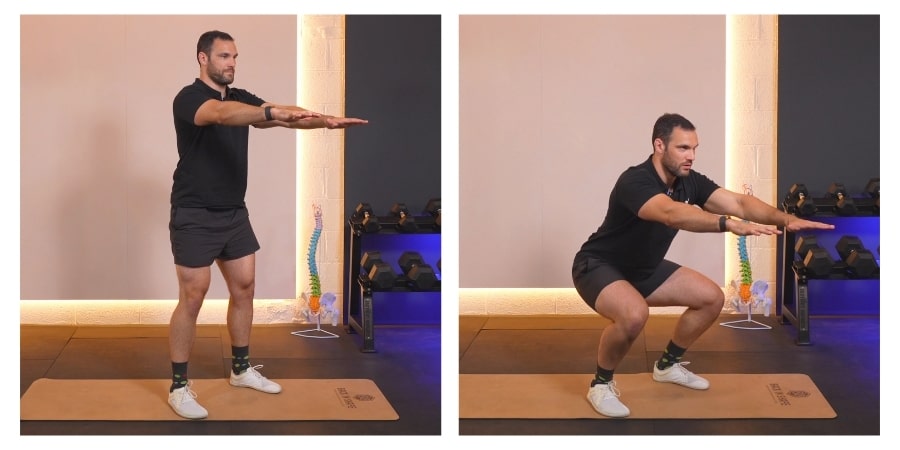
Squat: weightbearing spine stability
The squat is an exercise that we all do daily, and primarily challenges us in the flexion direction. Most who fail on this movement round the lower back or collapse the torso forwards. Flexion or forward bending is the primary mode of direction that most with back pain fall into when they “injure their back”. Prevention of uncontrolled movement like this is vital, but many are not very aware of this even happening. They lack both the strength and flexibility to perform such a movement competently.
For those that struggle, it can be made easier in a number of ways such as with supports, or shallower depth of reps, and more importantly, it can be made harder and harder with more depth and more load. The squat, like the next exercise we cover, is perfect, once mastered for building spine strength. It creates an incredibly safe environment with which we can steadily apply more load to the back to drive adaptations and increases in tolerance for load.
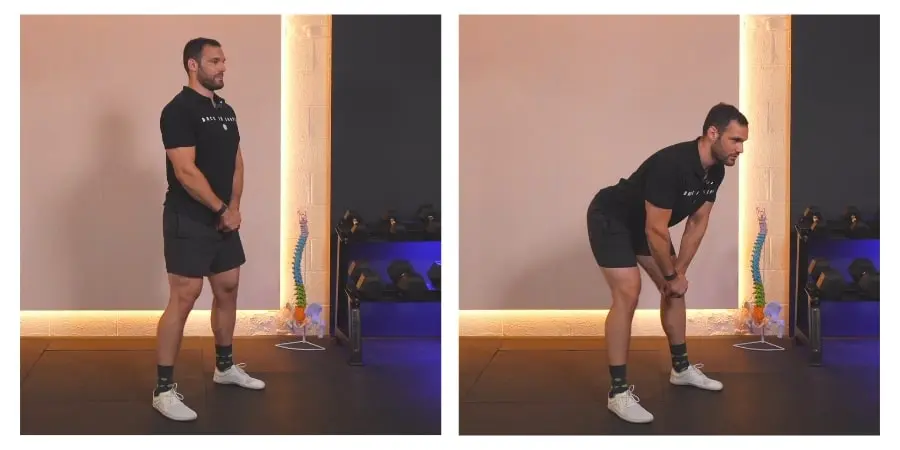
Hip hinge: weightbearing stability
Another fantastic movement that we all do every day, challenging the same movement as a squat, but in a slightly different way. It is peculiar in that many who squat very well, will struggle tremendously with the hip hingeing movement, unable to isolate the hip movement from the spine movement to perform the hip hinge, instead craning over and rounding the lower back. Commonly it is not so much the bum tucking under, like in the squat, but more the torso collapsing forwards from the top down.
This movement can again be made easier by limiting the range, using supports and importantly it can be scaled by adding load by way of bands, dumbbells and barbells. It also provides a fantastic mechanism for increasing the load we can expose the low back to in a way that can doesn’t challenge the knees as much. Unfortunately many who have chronic lower back issues frequently have poor knee health, and will often be limited in progress because of the knees rather than the low back, and so this can give you a mechanism to continue to build back strength while the knees catch up!
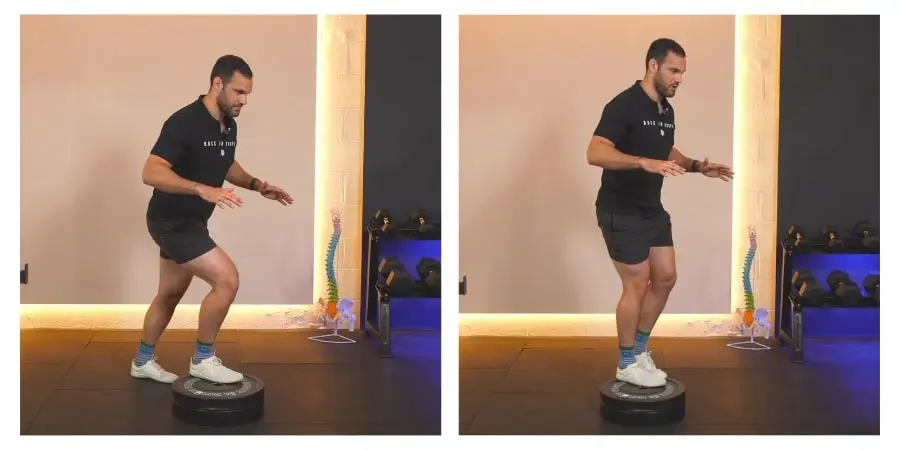
Step up: asymmetrical load and balance
As you will know, much of life is not balanced, we carry shopping bags, our kids, suitcases, and more on one side or another, we slip on one leg or another, and improving our ability to balance with load, while driving through one leg, like on the marching bridge, is vital. The step up challenges your spine in the left to right plane, with the main mistake at the level of the spine being a tilting or dropping of the pelvis to one side.
Just like the other load bearing exercises, the step up can be made easier with support such as using the bannister at the bottom of the staircase, or harder with the addition of weight, bands or higher steps! Although this might not be like the squat or hip hinge in terms of load, the challenge to the balance, and coordination is excellent at building your stability in a more dynamic way that is safe for all.
Other strategies and exercises to build back health
While there will be other exercises, and types of training which may well become relevant in the future, the “core 5 for spine health” are just that because they build the foundation, and when done correctly, can really build a significant amount of resilience back into the system. Granted there are other more advanced training modes and options that you can employ, but if you focus on the foundation first, those of you with more athletic ambition can work to enhance things further at the right time AFTER you’ve made significant progress on these.
A word on spinal flexibility: when should it be added in
The flexibility of the spine is something that is frequently cited, and most of you will have been told your back is stiff and needs to move and that’s why you’re in pain. Hence the knee hugs and twists you so frequently get given. But understand this is not an early stage rehab activity. Focus on building the “core 5” to a good level first. Then you can consider the need to add spine mobility back into the mix.
People always want to know how much strength do I need? Improvised from Dr Peter Attia’s work in his book outlive, we suggest for a 40 year old, the ability to perform 10 reps with a good range of either a hip hinge or squat with 100% of your bodyweight for men and 75% for women, would be a great target that if achieved without pain would illustrate a good health in the lower back in terms of the spines structural stability to bear load. The reality is most will find that they feel MUCH BETTER long before they’re anywhere near this level, but with the squat and hip hinge performed with a neutral spine, the discs and ligaments are in their best load bearing position and so testing out higher challenge positions that focus strain on particular parts of the disc or supporting structures of the spine, could more reasonably be pursued at this point with plausibly lower risk of injury, aggravation or setback. Although care should still be taken when doing so, and you should make sure your hip mobility is adequate first!
Final thoughts on the “Core 5 For Spine Health”
This selection of 5 exercises for spine health have been used as the primary stability drivers for so many over the years and the more time goes by the more it is clear that they work as excellent testing metrics, in so much that you can evaluate back health & resilience by someone’s ability to perform them. But not only that, the test is the exercise, meaning you’re going to repeatedly use the exercise to improve your test results. For example, if you cannot barely perform a squat without pain or serious form failure, you can repeatedly practice the variations of the squat to master this and then add weight to further improve. So when it comes to re-testing the squat as a surrogate measure of spine health, you can see the improvement clearly with a before and after. This makes improvement so easy to see and measure!
If you need any more help with these movements, recovering from your back pain or sciatica, or support on your own journey to getting your “back in shape”, then check out the wealth of information and education on the website and in the membership!


